Drive through any older Phoenix or East Valley neighborhood and you'll see it: block after block of flat-roofed homes. That's not an accident. Flat roofs handle Arizona heat efficiently, cost less to build and maintain, and give you usable space a pitched roof can't. Here's the full picture from someone who works on them every week.
Key takeaways
- Flat roofs suit Arizona's hot climate. With reflective coatings they bounce back UV radiation, improve energy efficiency, and lower cooling costs.
- The simpler design means less material and labor, which keeps both construction and maintenance costs down.
- Durability depends on the right material, usually polyurethane foam here in the Valley, and on keeping drains clear so monsoon rain doesn't pond.
Built for Arizona's heat
Flat roofs are popular across metro Phoenix because they manage extreme heat well. A properly coated flat roof reflects a large share of the sun's UV radiation instead of soaking it in, which keeps attic and interior temperatures down during the brutal summer months. Less heat coming through the roof means the air conditioner runs less, and that shows up on your utility bill.
They're also simpler to work on. When a flat roof needs recoating or repair, the access is easy and the surface is walkable, so labor time (and cost) is lower than on a steep tile or shingle roof.
Cost-effective construction
A flat roof uses fewer materials and less labor to build than a pitched roof of the same footprint. There are no trusses framing a tall attic, no field of tile or shingles, just a deck, insulation, and a membrane or foam system. That simplicity is a big part of why so much of Arizona's post-war housing was built this way, and why flat roofs are still standard on additions, garages, and patio covers today.
Material choice drives the price. In the East Valley the most common flat roof systems are sprayed polyurethane foam, modified bitumen, and older tar-and-gravel builds. If you're weighing options, my Arizona roof replacement cost guide covers what actually moves the number.
Maximizing usable space
A flat roof gives you square footage a sloped roof simply can't. Homeowners use it for rooftop decks and patios, and builders love it for tucking HVAC units up and out of sight where they're easy to service. Inside, the flat profile means you're not paying to heat and cool a big triangular attic full of air.
Durability and low maintenance in the desert
Flat roofs hold up well in arid conditions when the material matches the climate. Sprayed polyurethane foam is the local favorite for a reason: it's lightweight, seamless, waterproof, and handles the expansion and contraction that comes with our 40 degree daily temperature swings. Modified bitumen is another solid performer that reflects solar heat when coated.
The maintenance list is short but real: recoat on schedule (roughly every five years for foam with an elastomeric coating), keep debris off the surface, and make sure drains and scuppers stay clear. Skip those and small problems turn into leaks.
Not sure what shape your flat roof is in?
I inspect flat and foam roofs all over the East Valley. The inspection costs nothing, I do it personally, and you get a straight answer about coating, drainage, and whether anything actually needs work.
Call or text Andy: 480-363-2898Aesthetics and architecture
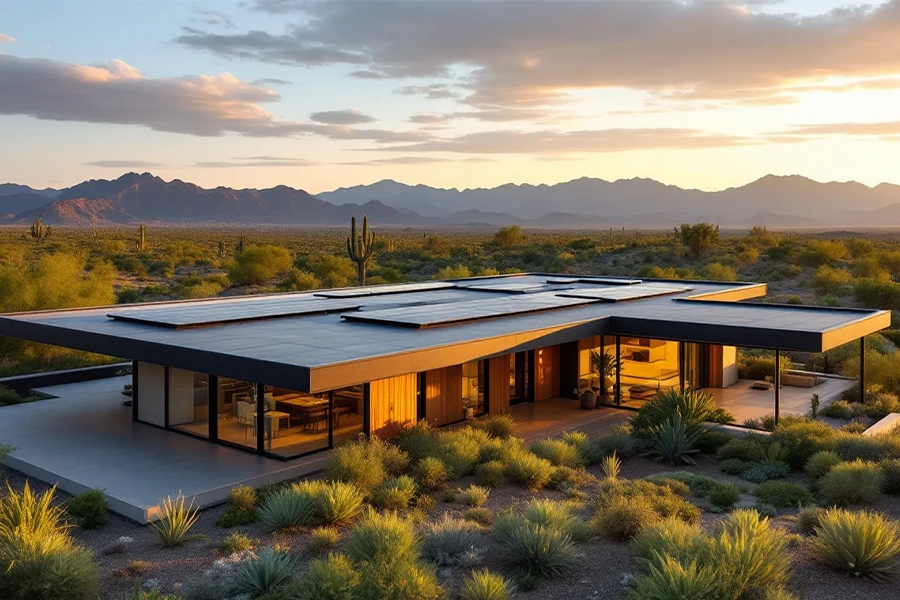
Flat roofs aren't just practical. They define the look of Southwestern, Pueblo Revival, and midcentury modern homes, with clean lines that fit the desert landscape. Modern custom builds in Chandler and Gilbert keep choosing them for exactly that reason. And solar panels sit lower and less obtrusively on a flat roof than on a pitched one, so the house keeps its lines.
Water drainage: the one thing you have to get right
The knock on flat roofs is water, and during monsoon season it's a fair concern. A "flat" roof is never actually dead flat; it's built with slight slope toward interior drains or scuppers (openings at the roof edge) that move rain off the surface. When those stay clear, a flat roof sheds a summer storm just fine. When they clog, water ponds, and ponding water finds weaknesses.
The fix is simple: check drains and scuppers before monsoon season, clear debris, and have the roof looked at twice a year. A free roof inspection before the storms hit catches ponding areas and coating wear while they're still cheap to address.
Energy efficiency and solar
Flat roofs pair naturally with solar. Panels can be set at the ideal angle with ballasted racking that doesn't penetrate the roof, installation is safer and faster, and the panels are barely visible from the street. Combined with a reflective coating, a flat roof is one of the most energy-efficient setups an Arizona home can have. If you're considering panels, read my guide on replacing a roof with solar panels first, because sequencing matters.
Common flat roof materials in Arizona
- Sprayed polyurethane foam: the most popular flat roof system in Arizona. Seamless, insulating, and long-lasting when recoated on schedule. Here's how foam roofs work.
- Modified bitumen: rolled asphalt-based membrane, often reinforced with fiberglass or polyester. Good waterproofing at a moderate price.
- Tar and gravel (built-up): common on older homes. Serviceable, but most get converted to foam at replacement time.
- Single-ply membranes (TPO, EPDM, PVC): more common on commercial buildings, occasionally used on homes.
Common questions
Do flat roofs leak more than pitched roofs?
Not when they're maintained. Almost every flat roof leak I see traces back to a clogged drain, a coating that was never renewed, or a bad patch job. The design isn't the problem; neglect is.
How long does a flat roof last in Arizona?
A foam roof that gets recoated on schedule can keep going for decades; the coating is the sacrificial layer, not the roof itself. See my full guide on foam roof life expectancy.
Can I put solar on a flat roof?
Yes, and it's often easier than on tile. Just make sure the roof surface has enough life left before panels go up, because removing them later to fix the roof gets expensive.